
August 10, 2026
BGMEA and BEZA Investors Association Hold Meeting on Creating an Investment-Friendly Environment in Economic Zones
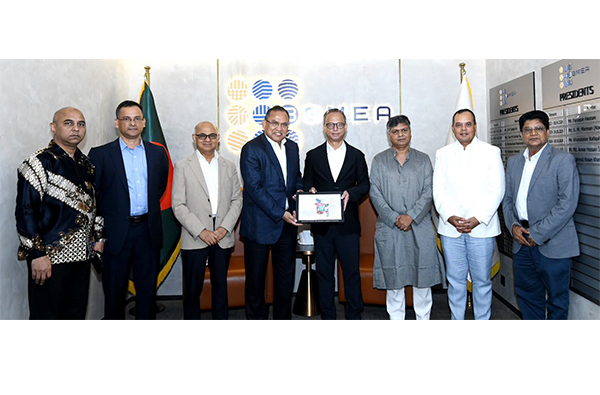
A high-level bilateral meeting between the Bangladesh Garment Manufacturers and Exporters Association (BGMEA) and the Bangladesh Economic Zones Investors Association (BEZIA) was held on 10 August 2026 at the BGMEA Complex in Uttara to accelerate new investment in economic zones and address existing infrastructural and policy challenges faced by investors.
The BEZIA delegation was led by its President M. A. Jabbar. Other members of the delegation included BEZIA Vice President Md. Halimuzzaman, Director Delwar H. Titu, CEO Dr. Aporup Chowdhury, and member Md. Mustafizur Rahman. The meeting was led on behalf of BGMEA by President Mahmud Hasan Khan. BGMEA Vice President (Finance) Mijanur Rahman also participated in the discussion.
The meeting held a productive discussion on the current progress of plots allocated in five government economic zones, which have been identified for full operationalization as part of the government’s short-term priorities, as well as various policy-related challenges faced by investors.
BEZIA President M. A. Jabbar said that many entrepreneurs have already paid substantial amounts of money for plots but are losing confidence due to the slow development of infrastructure and utility facilities. As a result, only 27 enterprises are currently in production across the five zones, covering approximately 39,000 acres of land, while only 37% of the total allocated land is currently operational. The meeting emphasized the need for joint advocacy to address the shortage of uninterrupted gas and industrial water supplies and to oppose the imposition of additional service charges before factories become fully operational.
To ensure an investment-friendly environment, both organizations agreed to jointly raise several key policy issues with the government at the highest level.
The meeting strongly called for a complete waiver of service charges imposed by BEZA on utility bills until the promised uninterrupted utility services are ensured. It was also emphasized that sector-specific cash incentives equivalent to those available to enterprises outside economic zones should be provided to zone-based investor units in order to ensure a level playing field.
The meeting further called for the complete waiver of VAT on lease tariffs to eliminate the issue of double taxation arising from the obligation to pay VAT at a rate of 15% at both the master leaseholder and subsequent sub-lessee levels. Special emphasis was also placed on allowing deemed export activities to domestic bond-licensed exporters without EXP and EP documents, in order to reduce administrative complexities and unnecessary delays.
The meeting also stressed the importance of making the mutation of 99-year leases bankable and ensuring the effective implementation of the One-Stop Service.
During the discussion, BEZIA President M. A. Jabbar specifically mentioned that 41 BGMEA member investor units are located in the National Special Economic Zone in Mirsarai, Chattogram. In this context, he noted that there is strong scope and rationale for BGMEA and BEZIA to work together on various national and policy issues concerning the garment sector.
Considering this, and with the aim of ensuring sustainable industrialization in economic zones and further strengthening coordination between the two organizations, BEZIA President M. A. Jabbar earnestly requested the inclusion of a BGMEA representative on the BEZIA Board of Directors.
BGMEA President Mahmud Hasan Khan welcomed the proposal and expressed his consent, assuring that BGMEA would nominate a suitable representative at the earliest.
At the conclusion of the meeting, the top leaders of both organizations expressed strong optimism that the far-reaching joint policy advocacy by BGMEA and BEZIA would encourage the Bangladesh Economic Zones Authority (BEZA) to take prompt and transformative measures to address infrastructural challenges and policy complexities in the economic zones.

Copyright © 2020, The Bangladesh Garment Manufacturers and Exporters Association.
Version-2.0, Design & Developed by Systech Digital Limited.